 Add to Chrome
 Add to Firefox
 Add to Edge
SE-DiCoW: Self-Enrolled Diarization-Conditioned Whisper
Jan 27, 2026
Speaker-attributed automatic speech recognition (ASR) in multi-speaker environments remains a major challenge. While some approaches achieve strong performance when fine-tuned on specific domains, few systems generalize well across out-of-domain datasets. Our prior work, Diarization-Conditioned Whisper (DiCoW), leverages speaker diarization outputs as conditioning information and, with minimal fine-tuning, demonstrated strong multilingual and multi-domain performance. In this paper, we address a key limitation of DiCoW: ambiguity in Silence-Target-Non-target-Overlap (STNO) masks, where two or more fully overlapping speakers may have nearly identical conditioning despite differing transcriptions. We introduce SE-DiCoW (Self-Enrolled Diarization-Conditioned Whisper), which uses diarization output to locate an enrollment segment anywhere in the conversation where the target speaker is most active. This enrollment segment is used as fixed conditioning via cross-attention at each encoder layer. We further refine DiCoW with improved data segmentation, model initialization, and augmentation. Together, these advances yield substantial gains: SE-DiCoW reduces macro-averaged tcpWER by 52.4% relative to the original DiCoW on the EMMA MT-ASR benchmark.

The CMU-AIST submission for the ICME 2025 Audio Encoder Challenge
Jan 22, 2026This technical report describes our submission to the ICME 2025 audio encoder challenge. Our submitted system is built on BEATs, a masked speech token prediction based audio encoder. We extend the BEATs model using 74,000 hours of data derived from various speech, music, and sound corpora and scale its architecture upto 300 million parameters. We experiment with speech-heavy and balanced pre-training mixtures to study the impact of different domains on final performance. Our submitted system consists of an ensemble of the Dasheng 1.2 billion model with two custom scaled-up BEATs models trained on the aforementioned pre-training data mixtures. We also propose a simple ensembling technique that retains the best capabilities of constituent models and surpasses both the baseline and Dasheng 1.2B. For open science, we publicly release our trained checkpoints via huggingface at https://huggingface.co/shikhar7ssu/OpenBEATs-ICME-SOUND and https://huggingface.co/shikhar7ssu/OpenBEATs-ICME.
ICASSP 2026 URGENT Speech Enhancement Challenge
Jan 20, 2026The ICASSP 2026 URGENT Challenge advances the series by focusing on universal speech enhancement (SE) systems that handle diverse distortions, domains, and input conditions. This overview paper details the challenge's motivation, task definitions, datasets, baseline systems, evaluation protocols, and results. The challenge is divided into two complementary tracks. Track 1 focuses on universal speech enhancement, while Track 2 introduces speech quality assessment for enhanced speech. The challenge attracted over 80 team registrations, with 29 submitting valid entries, demonstrating significant community interest in robust SE technologies.
CS-FLEURS: A Massively Multilingual and Code-Switched Speech Dataset
Sep 17, 2025We present CS-FLEURS, a new dataset for developing and evaluating code-switched speech recognition and translation systems beyond high-resourced languages. CS-FLEURS consists of 4 test sets which cover in total 113 unique code-switched language pairs across 52 languages: 1) a 14 X-English language pair set with real voices reading synthetically generated code-switched sentences, 2) a 16 X-English language pair set with generative text-to-speech 3) a 60 {Arabic, Mandarin, Hindi, Spanish}-X language pair set with the generative text-to-speech, and 4) a 45 X-English lower-resourced language pair test set with concatenative text-to-speech. Besides the four test sets, CS-FLEURS also provides a training set with 128 hours of generative text-to-speech data across 16 X-English language pairs. Our hope is that CS-FLEURS helps to broaden the scope of future code-switched speech research. Dataset link: https://huggingface.co/datasets/byan/cs-fleurs.
MAPSS: Manifold-based Assessment of Perceptual Source Separation
Sep 11, 2025Objective assessment of source-separation systems still mismatches subjective human perception, especially when leakage and self-distortion interact. We introduce the Perceptual Separation (PS) and Perceptual Match (PM), the first pair of measures that functionally isolate these two factors. Our intrusive method begins with generating a bank of fundamental distortions for each reference waveform signal in the mixture. Distortions, references, and their respective system outputs from all sources are then independently encoded by a pre-trained self-supervised learning model. These representations are aggregated and projected onto a manifold via diffusion maps, which aligns Euclidean distances on the manifold with dissimilarities of the encoded waveforms. On this manifold, the PM measures the Mahalanobis distance from each output to its attributed cluster that consists of its reference and distortions embeddings, capturing self-distortion. The PS accounts for the Mahalanobis distance of the output to the attributed and to the closest non-attributed clusters, quantifying leakage. Both measures are differentiable and granular, operating at a resolution as low as 50 frames per second. We further derive, for both measures, deterministic error radius and non-asymptotic, high-probability confidence intervals (CIs). Experiments on English, Spanish, and music mixtures show that the PS and PM nearly always achieve the highest linear correlation coefficients with human mean-opinion scores than 14 competitors, reaching as high as 86.36% for speech and 87.21% for music. We observe, at worst, an error radius of 1.39% and a probabilistic 95% CI of 12.21% for these coefficients, which improves reliable and informed evaluation. Using mutual information, the measures complement each other most as their values decrease, suggesting they are jointly more informative as system performance degrades.
OpenBEATs: A Fully Open-Source General-Purpose Audio Encoder
Jul 18, 2025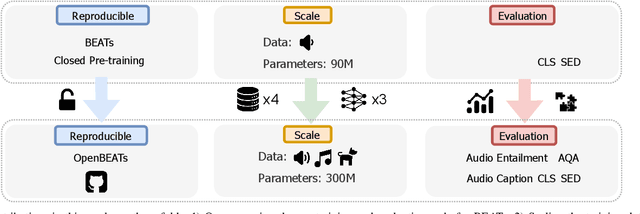

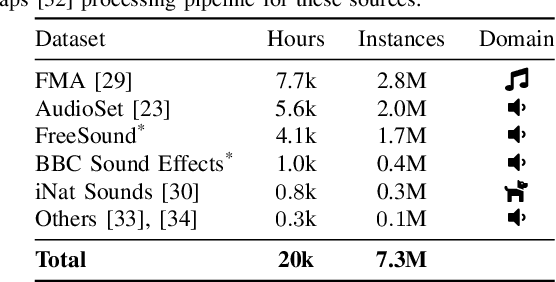
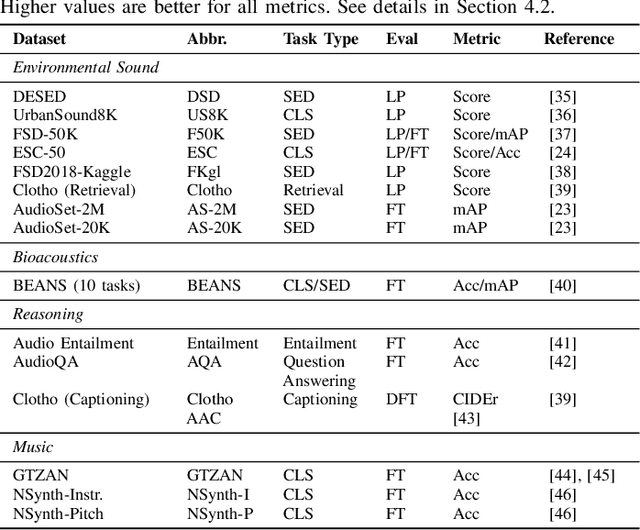
Masked token prediction has emerged as a powerful pre-training objective across language, vision, and speech, offering the potential to unify these diverse modalities through a single pre-training task. However, its application for general audio understanding remains underexplored, with BEATs being the only notable example. BEATs has seen limited modifications due to the absence of open-source pre-training code. Furthermore, BEATs was trained only on AudioSet, restricting its broader downstream applicability. To address these gaps, we present OpenBEATs, an open-source framework that extends BEATs via multi-domain audio pre-training. We conduct comprehensive evaluations across six types of tasks, twenty five datasets, and three audio domains, including audio reasoning tasks such as audio question answering, entailment, and captioning. OpenBEATs achieves state-of-the-art performance on six bioacoustics datasets, two environmental sound datasets and five reasoning datasets, performing better than models exceeding a billion parameters at one-fourth their parameter size. These results demonstrate the effectiveness of multi-domain datasets and masked token prediction task to learn general-purpose audio representations. To promote further research and reproducibility, we release all pre-training and evaluation code, pretrained and fine-tuned checkpoints, and training logs at https://shikhar-s.github.io/OpenBEATs
BUT System for the MLC-SLM Challenge
Jun 16, 2025
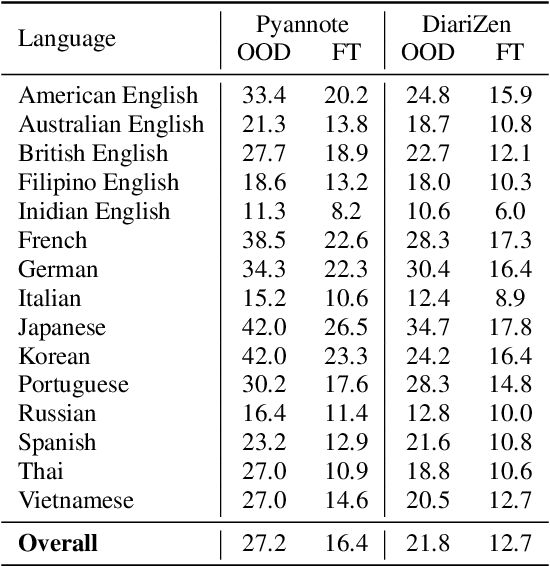
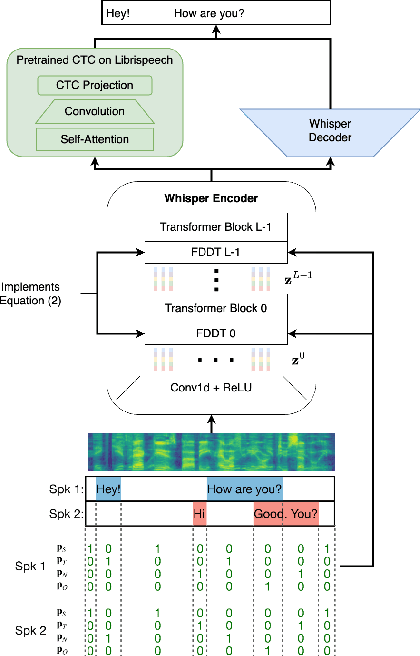
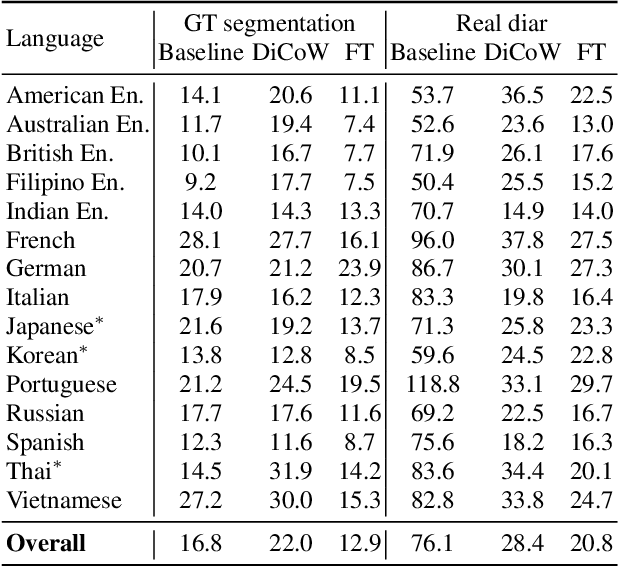
We present a two-speaker automatic speech recognition (ASR) system that combines DiCoW -- a diarization-conditioned variant of Whisper -- with DiariZen, a diarization pipeline built on top of Pyannote. We first evaluate both systems in out-of-domain (OOD) multilingual scenarios without any fine-tuning. In this scenario, DiariZen consistently outperforms the baseline Pyannote diarization model, demonstrating strong generalization. Despite being fine-tuned on English-only data for target-speaker ASR, DiCoW retains solid multilingual performance, indicating that encoder modifications preserve Whisper's multilingual capabilities. We then fine-tune both DiCoW and DiariZen on the MLC-SLM challenge data. The fine-tuned DiariZen continues to outperform the fine-tuned Pyannote baseline, while DiCoW sees further gains from domain adaptation. Our final system achieves a micro-average tcpWER/CER of 16.75% and ranks second in Task 2 of the MLC-SLM challenge. Lastly, we identify several labeling inconsistencies in the training data -- such as missing speech segments and incorrect silence annotations -- which can hinder diarization fine-tuning. We propose simple mitigation strategies to address these issues and improve system robustness.
ARECHO: Autoregressive Evaluation via Chain-Based Hypothesis Optimization for Speech Multi-Metric Estimation
May 30, 2025Speech signal analysis poses significant challenges, particularly in tasks such as speech quality evaluation and profiling, where the goal is to predict multiple perceptual and objective metrics. For instance, metrics like PESQ (Perceptual Evaluation of Speech Quality), STOI (Short-Time Objective Intelligibility), and MOS (Mean Opinion Score) each capture different aspects of speech quality. However, these metrics often have different scales, assumptions, and dependencies, making joint estimation non-trivial. To address these issues, we introduce ARECHO (Autoregressive Evaluation via Chain-based Hypothesis Optimization), a chain-based, versatile evaluation system for speech assessment grounded in autoregressive dependency modeling. ARECHO is distinguished by three key innovations: (1) a comprehensive speech information tokenization pipeline; (2) a dynamic classifier chain that explicitly captures inter-metric dependencies; and (3) a two-step confidence-oriented decoding algorithm that enhances inference reliability. Experiments demonstrate that ARECHO significantly outperforms the baseline framework across diverse evaluation scenarios, including enhanced speech analysis, speech generation evaluation, and noisy speech evaluation. Furthermore, its dynamic dependency modeling improves interpretability by capturing inter-metric relationships.
Interspeech 2025 URGENT Speech Enhancement Challenge
May 29, 2025There has been a growing effort to develop universal speech enhancement (SE) to handle inputs with various speech distortions and recording conditions. The URGENT Challenge series aims to foster such universal SE by embracing a broad range of distortion types, increasing data diversity, and incorporating extensive evaluation metrics. This work introduces the Interspeech 2025 URGENT Challenge, the second edition of the series, to explore several aspects that have received limited attention so far: language dependency, universality for more distortion types, data scalability, and the effectiveness of using noisy training data. We received 32 submissions, where the best system uses a discriminative model, while most other competitive ones are hybrid methods. Analysis reveals some key findings: (i) some generative or hybrid approaches are preferred in subjective evaluations over the top discriminative model, and (ii) purely generative SE models can exhibit language dependency.
ESPnet-SpeechLM: An Open Speech Language Model Toolkit
Feb 21, 2025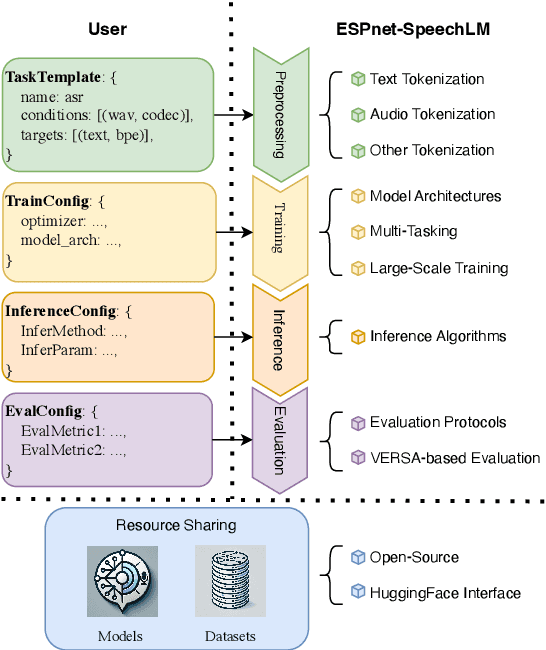
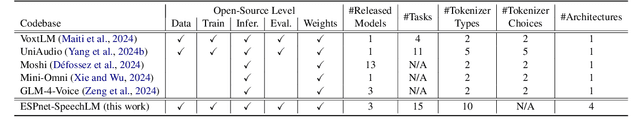
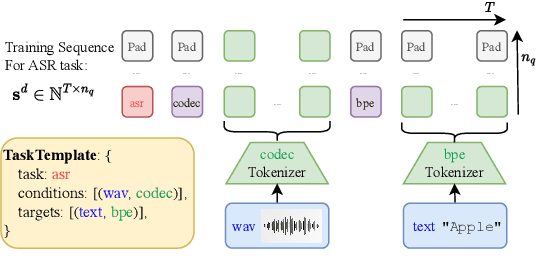
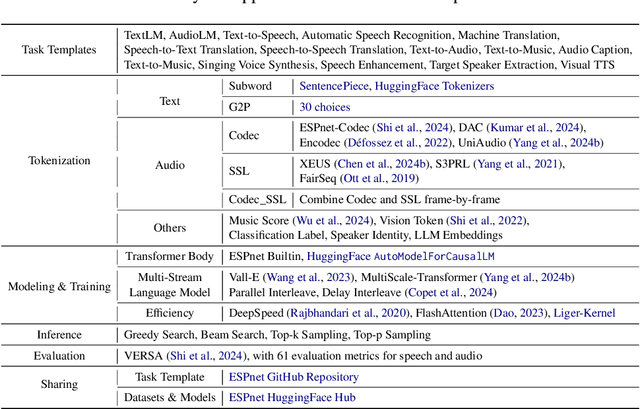
We present ESPnet-SpeechLM, an open toolkit designed to democratize the development of speech language models (SpeechLMs) and voice-driven agentic applications. The toolkit standardizes speech processing tasks by framing them as universal sequential modeling problems, encompassing a cohesive workflow of data preprocessing, pre-training, inference, and task evaluation. With ESPnet-SpeechLM, users can easily define task templates and configure key settings, enabling seamless and streamlined SpeechLM development. The toolkit ensures flexibility, efficiency, and scalability by offering highly configurable modules for every stage of the workflow. To illustrate its capabilities, we provide multiple use cases demonstrating how competitive SpeechLMs can be constructed with ESPnet-SpeechLM, including a 1.7B-parameter model pre-trained on both text and speech tasks, across diverse benchmarks. The toolkit and its recipes are fully transparent and reproducible at: https://github.com/espnet/espnet/tree/speechlm.